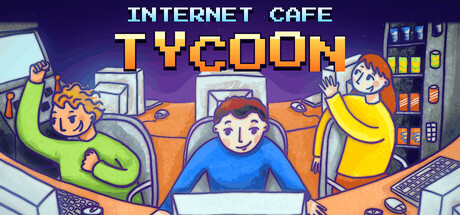
Internet Cafe Tycoon
Run a 2000s internet cafe. Hire a literal ghost apprentice, survive the city inspector, break up brawling groups — and end each day in MAIL.EXE, where every message has a price. Seven playable arcade cabinets, three difficulties, free demo.
Welcome to the golden age of internet cafes
The late 90s. A row of CRTs humming in unison. An MSN chime in one corner, a Counter-Strike round closing out with that classic "Terrorists Win" in the other. The keys are yours. Your first customer just walked in.
Internet Cafe Tycoon drops you into the rush of running a 2000s internet cafe. Seat customers, sell drinks, scrape past the inspector, pull apart fights, and try to become Internet King by the end of a 30-day run.
Build it, run it, grow it
You start with a shop key, a few PCs and a dream. Extra hardware, a fuller till, or the neighbourhood's trust — three starting builds send the early game in completely different directions. Buy vending machines, replace ageing gear, open the arcade hall, and scale to 10 PCs for the evening rush.
And right-click anything: what the customer at that desk wants, how much life the machine has left, what the vending stock looks like — one small window, while the cafe keeps running behind it.
Hire a ghost apprentice
You read that right. A ghost apprentice drifts through the walls carrying orders, works the vending machines and — once you train them — flies over to break up fights. Three promotion tiers make them faster. Hire a second one when the till allows.
Work the floor
Seat the regulars, spoil the VIPs, politely turn away the underage kid before the inspector writes you up. And pray two rival clans never end up waiting side by side: when they do, they start swinging while they wait for a seat, and your reputation goes down with them.
Cafe Rules, unlocked at Lv.1, turns those reflexes into policy: shut the vending machines, refuse minors outright, turn groups away at the door, close the arcade hall, reserve the last desk for VIPs. Each rule is a real trade — every door you close costs you the money behind it.
Seven playable arcade cabinets
Each one an actual mini-game you play: MAZE, FIGHT, STEEL BALL, RACE, SPACE DEFENSE, GUNNER, BEAT. Some customers want a PC, some want a specific cabinet. Wrong cabinet means half pay and a sour face; the right one means full pay and a regular for life. Cabinets bank their takings inside — let the coin box fill and customers start playing for free, so empty it now and then.
The day ends in the mail
Shutters down, MAIL.EXE up. The day-end screen is a mail client now: your landlord offers a rent cut for paying up front, the shop across the road wants to hand out free tea for three days, the city comes knocking, a rival cafe opens.
Every mail has a recipient, a sender and a reply-by day — or just ignore it. Every offer has two sides: refusing costs you something too, and both prices are written down before you choose. Twenty-nine different mail events.
Something goes wrong every day — on three difficulties
Blackouts, slow internet, virus outbreaks, city inspections, customer birthdays and the occasional pirated-software scare. Every day hands you a decision. Easy is for the atmosphere (PCs never die outright), Standard is what the game was designed around, and Challenger brings tight budgets, harsh reputation hits and a weekly tax that genuinely hurts. And if you get cornered, there is a way out: repairs on credit, or a free patch-up that brings a desk back bruised but alive — nobody gets stuck in this cafe.
20 levels, 23 perks
A twenty-rung ladder that unlocks something on almost every step. At each level you pick from the Common, Uncommon and Rare pools to suit how you play: a fast-internet setup, a tip-fed empire, or a security operation that smothers fights before they start.
Authentic 2000s texture
CRT scanlines, pixel art worked down to individual customer walk cycles, period game posters on the walls, and calm lo-fi under the daytime bustle — which kicks into something livelier once you buy the music system. What customers are actually doing is real too: Metin2 sessions, MSN chats, IRC veterans, and the kid in the corner pretending to do homework. Every cafe comes with a cat. (You get to name it.)
Fully playable in 8 languages. Five independent save slots mirror to Steam Cloud — run as many cafes as you like, side by side.
Demo
The demo is a focused 12-day, Level 10 slice — close to an hour of play. You meet the apprentice system, open the arcade on day one (and buy a second cabinet if the till allows), wrestle with your first weekly inspection, and end each day in MAIL.EXE.
What the full version adds
Levels 10-20, all seven arcade cabinets, the full 30-day campaign
The late-game mail and offers: rival cafes, sponsorships, the city award, fibre rollout, university deals
The closing bell and relax-mode mini-games
Challenger difficulty for tycoon veterans
3 starting builds that reshape the early game
23 perks across three rarity tiers