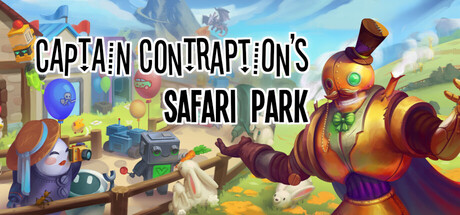
Captain Contraption’s Safari Park
A pixel-art roguelite safari park sim. Clone lions, medieval knights and sentient trucks into a park with no fences, then route your visitors past the chaos. You control the paths, the buildings and your robot staff. The one thing you don’t control is the animals.
From the two-person team behind Captain Contraption’s Chocolate Factory comes a pixel-art roguelite park management sim.
You’re a robot historian. Humanity is long extinct, and you are studying it the only way you know how… by cloning the creatures you found on a hard-drive, releasing them into a safari park, and selling tickets to your robot friends.
There are no fences. There are no enclosures. Nothing stays where you put it.
Every creature acts on its own instincts. Herbivores graze and breed while Predators hunt them. Populations rise and fall, and rise again. Put a dragon nest downwind of the field your goats call home and watch what happens. Your job is to stay one step ahead of an ecosystem that doesn’t do what it’s told.
You don't control the animals. You control the visitors.
You build the paths, your guides follow them, visitors follow the guides. Get the route right and you have paying customers. Get it wrong and you have free food for the new dinosaur exhibit.
Every park ends in ruin. So you can learn and try again.
Sooner or later the food chain inverts, time runs out, or something gets loose in the gift shop. When a park falls that park ends, but the study doesn’t. This is a rougelite, meaning you earn currency each run to unlock: new creatures to clone, new attractions to build, and new systems that promise a little more control.
The archive of creatures is extensive… but poorly labelled.
As you get deeper into the game you’ll unlock more of what humanity left behind.
Lions, tigers and other creatures that behave roughly as you expect.
Medieval knights and orcs who settle their disagreements in public.
Sentient push bikes.
All of it runs on a mysterious green goop. Feed goop to a cloning vat and you get a creature. Feed it to a field and you get wheat. When something dies your Recycler Robot turns it back into goop (if something else doesn’t eat it first). Run out of goop, or money to buy goop, and the whole park starves.
We're Pill Bug Interactive, two chuckle heads in Wales making games. Wishlist Captain Contraption’s Safari park and we'll tell you the moment the demo is live.
Note on AI use during development
Every asset in this game was made by a human. The game started out as the idea of “Asset Safari” around the concept of buying sprite packs from artists, which is what we have done. The music, sound and writing is also all human generated.
I (Sean) use AI coding assistants: GitHub Copilot and Claude Code. I've written software for years and I teach games programming at university, and I use AI tools the way I use a profiler or a compiler. They helped build web tools Dave and I use to balance the ecosystem across long simulations, they're very good at finding edge-case bugs (I'm looking at you, pathing system), and they write the boilerplate for things like save states and UI. I never ship code I haven't read and thoroughly tested.
No content in this game is AI-generated, and no generative AI runs while you play.
Steam's disclosure question is about AI-generated content that ships in a game, not tools that speed up development, so we've answered no. But we're telling you about the tools we have used anyway.